
Carbon capture, utilization, and storage (CCUS) is central to industrial decarbonization, placing greater attention on materials that can selectively remove carbon dioxide from complex gas streams. Solid sorbents offer an alternative to energy-intensive liquid amine processes for direct air capture (DAC) and post-combustion capture (PCC). At molecular scale, their performance is governed by Carbon Dioxide (CO2) adsorption and the chemical and physical interactions that bind CO2 to a material’s surface.
Adsorption fundamentals: Physical vs. chemical capture
Adsorption describes the accumulation of molecules on a solid surface, whereas absorption involves uptake into the bulk of a material. For carbon capture, that distinction matters because surface chemistry, pore structure, and operating conditions determine how much CO2 a sorbent can retain and how readily the gas can later be released.
Physisorption is dominated by comparatively weak intermolecular attractions, particularly van der Waals forces. High-surface-area porous solids concentrate CO2 within small pores without forming strong chemical bonds. Lower binding energies can reduce the energy needed for regeneration, making physisorbents attractive for cyclic processes. Their limitation is a weaker affinity for CO2 and selectivity at very low CO2 partial pressures, including the approximately 400 ppm concentration encountered in ambient-air DAC.
Chemisorption follows a different pathway. Chemical interactions bind CO2 to reactive surface groups, often through acid-base chemistry. Stronger affinity can improve selectivity under dilute conditions, meaning chemisorbents are especially relevant to DAC. Enhanced binding strength, however, can increase the thermal energy required to regenerate the material. Effective CO2 adsorption therefore involves balancing CO2 affinity and selectivity while ensuring efficient capacity and maintaining regeneration requirements.
Materials and molecular mechanisms for CO2 capture
Different sorbent families exploit pore geometry, surface chemistry, or chemical reactions to capture CO2. Their molecular mechanisms influence where they can be used for different capture applications and the operating conditions under which they can perform effectively.
- Metal-organic frameworks (MOFs) and porous coordination polymers offer highly tunable crystalline pore networks. Carefully controlled micropore dimensions can influence molecular sieving, and electrostatic interactions or open metal sites can strengthen CO2 adsorption.
- Zeolites and activated carbons use extensive internal surface areas and nanoscale pore confinement to adsorb and retain CO2. Zeolite frameworks can offer strongly polar environments for CO2 adsorption, while activated carbon performance can be modified through pore-size distribution and surface chemistry.
- Amine-functionalized silica and polymer resins incorporate basic amine groups, often through compounds such as polyethyleneimine (PEI) and tetraethylenepentamine (TEPA). In these materials, CO2 adsorption involves chemical binding at reactive amine sites, typically forming carbamate species under dry or low humidity conditions. When water is present, suitable systems can also form bicarbonate species.
- Liquid-solid hybrid sorbents and alkali carbonates rely on reactive chemistry, phase behavior, or conversion reactions to bind CO2. Such materials can fit well with specialized capture processes involving elevated temperatures or chemically demanding industrial gas streams, depending on their composition and regeneration mechanisms.
Key material parameters governing CO2 capture
Practical CO2 capture performance cannot be judged from a single capacity value. Researchers need to examine several connected parameters to determine whether promising laboratory CO2 adsorption translates into an efficient capture process.
Adsorption isotherms quantify equilibrium uptake across defined CO2 partial pressures and temperatures. These measurements reveal the relationship between CO2 partial pressure and CO2 uptake under conditions suited to applications such as ambient-air DAC or CO2 removal from power-station flue gas. Kinetic measurements add the time dimension by showing how rapidly adsorption proceeds, informing mass-transfer behavior, contactor residence times, adsorbent bed dimensions, and process throughput.
Selectivity becomes equally important when other gases enter the system. Nitrogen and oxygen dominate many capture streams, meaning a sorbent must preferentially retain CO2 despite competition from other molecules. Which species competes depends on the capture application; for example, flue gas has an abundance of nitrogen, whereas ambient air can consist of nitrogen, oxygen, as well as water vapor.
Humidity adds another layer of complexity. Water vapor can occupy active sites, alter pore accessibility, or modify surface interactions. Conversely, moisture may enhance CO2 adsorption in certain amine-functionalized sorbents through changing the reaction pathway and enabling bicarbonate formation. The effect of humidity is therefore sorbent-specific.
Cyclic stability then determines if performance persists beyond an initial measurement. Commercial sorbents may undergo thousands of temperature-swing or pressure-swing cycles, depending on process design, so capacity retention, regeneration efficiency, and structural durability must be evaluated over repeated adsorption and desorption.
Characterizing CO2 adsorption under realistic conditions
Laboratory screening frequently uses pure CO2, dry gas, static conditions, or equilibrium measurements to isolate fundamental sorption behavior and establish baseline material behavior. Such experiments provide valuable reference data, but they may overlook competitive adsorption and transport effects that influence pilot-scale performance. A material showing high equilibrium capacity under pure gas can behave very differently inside a humid, multi-component process stream.
Using case-relevant sorption characterization brings experimental conditions closer to operating environments. DAC research needs measurements near atmospheric CO2 concentrations of approximately 400 ppm, alongside controlled relative humidity and temperature. PCC studies may need higher CO2 concentrations combined with water vapor, nitrogen, oxygen, and relevant process conditions. Dynamic flow experiments can reveal adsorption kinetics and breakthrough behavior, and repeated cycling exposes progressive changes in capacity or regeneration. Precision CO2 adsorption measurements must thus connect fundamental material properties with process-relevant performance to establish how laboratory-scale adsorption behavior translates into practical CO2 capture.
Advancing sorbent development through precision measurement
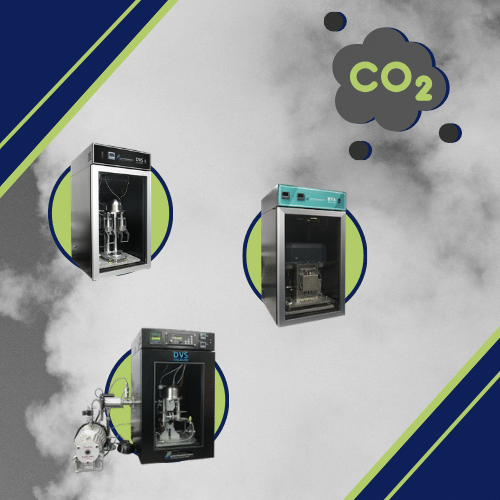
Surface Measurement Systems Ltd supports CO2 adsorption research with specialized analytical platforms spanning initial sorbent screening and application-focused evaluation. DVS Carbon measures CO2 uptake, adsorption kinetics, and CO2/H2O co-adsorption across controlled concentration, temperature, and humidity conditions, whereas BTA Frontier examines breakthrough curves, competitive adsorption, mixed-gas separation, and column dynamics under continuous flow. DVS Vacuum enables high-vacuum outgassing, wide-temperature sorption analysis, and isotherm measurements for establishing baseline material behavior. By linking molecular sorption data with realistic operating conditions, researchers can better assess and characterize the suitability of candidate sorbents for scalable CCUS applications. Contact Surface Measurement Systems Ltd to explore advanced sorption characterization for your carbon capture projects.