Traditional permeation testing can be slow and fragmented, with testing limited to a single gas/vapor. Membrane Permation Analysis is the new solution, delivering multi-component data in a single experiment, all in one compact instrument for faster, more confident decisions.
Definition
What is Membrane Permeation Analysis?
Membrane permeation analysis is a method used in polymer and separation science to evaluate the transmission rates and competitive permeation of gases and vapors through membranes and barrier films, to assess how well these materials function under real-world conditions
Global Application
The MPA Horizon transforms permeation analysis by enabling simultaneous measurement of multiple gases and vapours with high precision. Advanced sensors for oxygen, CO2, humidity and organic vapors allow for concurrent measurement of distinct gas and vapor transmission rates.
Methodology
How does MPA work?
In a typical membrane permeation analysis experiment, a membrane is introduced to a controlled gas/vapor mixture on one side of the membrane under a continuous flow. As they permeate through the membrane to the other side of the membrane, there is a sweep gas that moves the permeated gas/vapors to the outlet sensors. These sensors track the changing concentrations.
Ultra-trace O2 detection
Ppb-ppm level optical oxygen sensor, providing real-time oxygen transmission rate data between 0.05 – 500,000 cc m-2 day-1 under ASTM F2622-08.
Robust humidity generation and detection
Capacitance humidity probes for water vapour transmission analysis between 0.05 – 10,000 g m-2 day-1 under ISO 15106-1.
Variable sample holder diameter
Sample holder cartridges that can be easily swapped to allow for variation in the sample testing diameter. Cartridge sample diameters include: 2.1, 4.2, and 8.4 cm
Software Control
Live plotting of data from all the MFCs and sensors and comes with a method builder for creating complex experiments, along with a data analysis package.
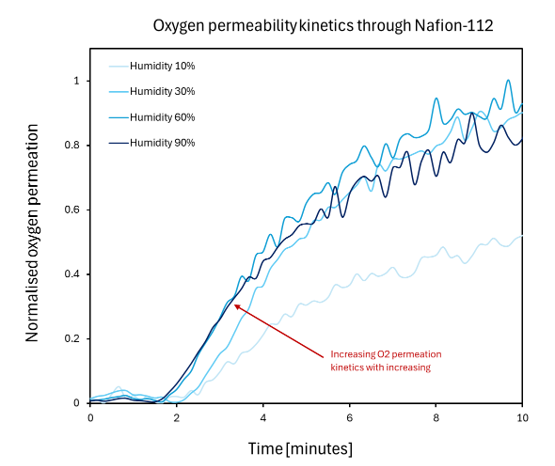
The output plot of concentration over time, called the permeation curve, allows for the determination of:
Permeation Kinetics
Transmission Rates
Membrane Selectivity
Common Applications
WVTR and OTR Analysis
Evaluating the WVTR and OTR for high barrier polymers
Fuel cells
Measurements of oxygen and water crossover, and He permeability
Gas Separations
Measure competitive and selective permeation
Food Packaging
WVTR, OTR, and food simulant assessments
Carbon Capture
Determining CO2 permeability under real-world conditions
Chemical Warfare Protection
Accurately determine permeability and filtration
The Next Horizon in Membrane Permeation Analysis
What unique innovative features have Surface Measurement Systems brought to Membrane Permeation Analysis?
Integrated Sensor Suite
Built-in O2, CO2, Relative Humidity, VOC, NH3, H2S, and a TCD sensor. With a software-integrated MS option
Multi-Gas Versatility
Up to 5 inlets for O2, CO2, He, VOC, N2, trace NH3, Methane, and H2S
Precision Vapor Control
Water vapor generation range of 0-95% RH
Flexible Sample Analysis Area
Changeable 8.4, 4.2, and 2.1 cm sample diameter
Multi-component Permeation
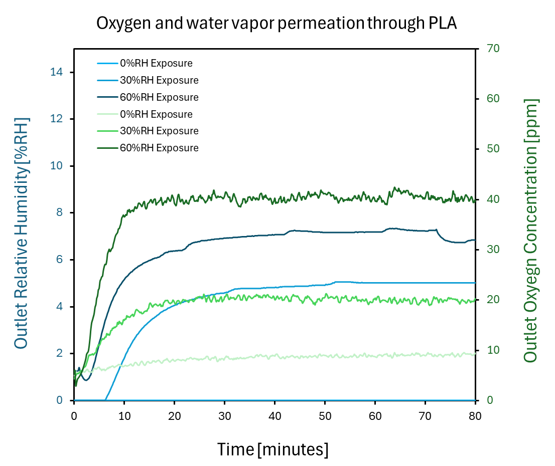
The combined outlet sensor suite allows for the concentrations of separate components to be measured independently
Wide Temperature Range
Sample holder temperature control up to 200 °C, with 5-60 °C for the incubator
Data Analysis
Multi-component Permeation Analysis
The MPA Horizon enables multi-component permeation studies, and transmission rate experiments, to reveal the competitive interactions between gases and vapors, and any changes in permeability due to changes in material morphology such as plasticization and phase transitions.