
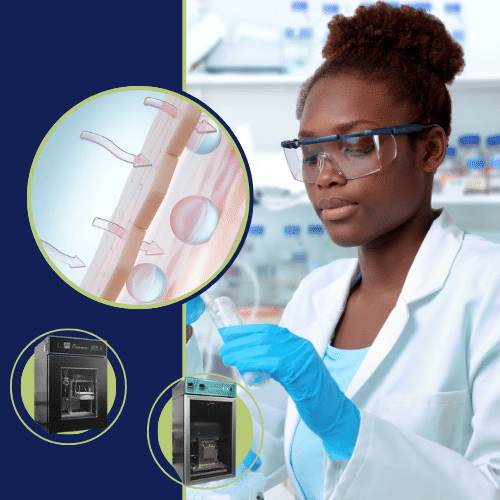
Even materials that form an effective physical barrier can permit gases and vapors to move through their internal structure. The extent of this molecular transport depends strongly on the material, with polymers, metals, porous solids, and composites exhibiting very different barrier properties. Permeation testing measures these variations under defined conditions, offering critical information for applications such as pharmaceutical packaging, hydrogen storage, fuel cells, carbon capture, and moisture-sensitive electronics.
Permeation testing & the solution-diffusion model
Gas transport within a dense material is a dynamic physicochemical process, not just flow along microscopic pathways. Permeation testing commonly interprets the transport of gas molecules through dense materials using the solution-diffusion model, which can be divided into three stages:
- Adsorption and absorption- gas molecules interact with the exposed surface before sorbing into the material
- Diffusion- molecules migrate through the internal structure along a concentration or chemical potential gradient
- Desorption- molecules reach the downstream surface and leave the material for the surrounding gas phase
Material architecture governs how readily these processes occur. Several structural differences are particularly important:
- Polymeric materials- amorphous regions generally have greater free volume and molecular mobility, providing additional opportunities for gas transport. Crystalline regions contain more ordered, closely packed chains that can form a stronger barrier
- Metals and glass- dense atomic networks generally restrict gas movement far more effectively than flexible polymer matrices, although defects and specific gas-material interactions can influence performance
- Porous materials- interconnected pores provide physical transport pathways. Depending on pore dimensions and pressure, gases may move through them via mechanisms including viscous flow or Knudsen diffusion
Environmental conditions add another variable. Increasing temperature can raise molecular mobility and accelerate diffusion. Relative humidity can also modify polymer behavior when absorbed water plasticizes the matrix, increasing chain mobility or free volume. Permeation testing under dry conditions may consequently produce very different results from measurements made in humid service environments.
Real-world gas mixtures complicate barrier performance
Practical environments rarely expose materials to one pure gas. Food packaging encounters oxygen and water vapor simultaneously. Post-combustion carbon capture sorbents contact humid mixtures containing carbon dioxide and nitrogen. Protective materials used for chemical storage may encounter volatile organic compounds (VOCs) alongside atmospheric gases.
Several effects can change material performance under varying conditions:
- Humidity effects- absorbed moisture can alter sorption behavior, polymer structure, and transport of gases such as oxygen or carbon dioxide
- Competitive sorption- multiple molecular species may compete for available sorption sites or influence transport pathways through the material, potentially changing solubility and diffusion properties
- Material degradation- prolonged exposure can cause swelling, plasticization, chemical changes, or other structural alterations that shift barrier properties over time
Permeation testing with realistic gas mixtures can expose behavior that isolated single-gas measurements may miss. A material that performs well against dry oxygen, for example, may exhibit a different transmission rate when water vapor is present. Therefore, it is crucial to evaluate permeation under conditions that reflect the gas composition and humidity expected in the intended application.
Measuring the transport of gases and vapors
Quantitative permeation testing provides several complementary measurements that describe both overall barrier performance and the mechanisms responsible for molecular transport:
- Transmission rate- measures total gas or vapor flux through a material. Water Vapor Transmission Rate (WVTR) and Oxygen Transmission Rate (OTR) are commonly used for food packaging films, pharmaceutical blister materials, and protective membranes
- Diffusion coefficient (D)- indicates how rapidly a permeating molecule migrates through the material
- Solubility coefficient (S)- describes how much of the permeating species dissolves within the material matrix
- Breakthrough time- records how long a gas takes to emerge from a packed bed or porous sorbent after exposure, providing information about retention and separation behavior
Traditional single-gas methods are still valuable for baseline characterization. Dynamic cross-flow approaches extend permeation testing into multi-component environments where temperature, relative humidity, concentration, and flow can be carefully controlled. Researchers can then examine competitive transport under conditions closer to those experienced by oxygen-barrier packaging, hydrogen separation membranes, carbon capture sorbents, and other functional materials.
Why permeation testing conditions matter when comparing materials
Comparing barrier materials is most useful when permeation testing reflects the conditions expected during use. A transmission rate measured under one environment cannot automatically represent performance under another. Important experimental variables include:
- Temperature- higher temperatures can increase molecular mobility and alter diffusion rates within polymers and membranes
- Relative humidity- water sorption can modify polymer structure and influence transport of other permeating species through processes such as plasticization, swelling, or competitive sorption
- Gas concentration and pressure- changes in the driving force across a material can affect measured flux and sorption behavior
- Sample thickness- film dimensions influence transmission measurements and must be considered when comparing materials
Controlling such variables ensures researchers can distinguish genuine material differences from changes caused by the test environment.
Enhancing gas and vapor permeation analysis with Surface Measurement Systems Ltd
Surface Measurement Systems Ltd supplies analytical platforms for examining permeation across different material architectures and operating environments. The MPA Horizon supports membrane permeation analysis (MPA), measuring competitive gas and vapor transport, including WVTR, OTR, and carbon dioxide, through films and membranes under controlled temperature and humidity. For packed beds and porous sorbents, the BTA Frontier measures single and multi-component breakthrough dynamics and gas separation kinetics.
Build a clearer picture of gas and vapor transport in your materials with Surface Measurement Systems Ltd. Speak with our experts today for guidance on selecting the right analytical approach for your permeation studies.