

This article is based on findings from our latest application note — Download the application note.
Ammonia remains one of the most widely encountered gaseous pollutants across industrial and environmental applications, driving strong demand for energy-efficient, scalable capture materials. Adsorption is one of the most straightforward mitigation strategies. It is simple, energy-efficient, and effective even at low concentrations.
But its success depends heavily on selecting the right sorbent material, and conventional testing often falls short: materials that perform well in the lab frequently behave differently once exposed to real-world conditions.
Selecting the optimal sorbents remains a difficult process, with conventional instruments often limited in their ability to provide meaningful insight into sorbent material behavior under realistic conditions.
That’s because real industrial air streams rarely contain ammonia alone. Water vapor is almost always present, and it can compete directly with ammonia for adsorption sites, drastically reducing a material’s capture capacity. Sorbents that look highly effective under dry lab conditions can see major performance loss once deployed in humid environments, and unless testing accounts for humidity and competing gases from the start, that gap can stay hidden until well into scale-up.
Why Ammonia Matters
- Agriculture: livestock ammonia affects animal welfare and worker health
- Wastewater treatment: odor and exposure issues from biological processes
- Manufacturing: contamination and corrosion in chemical processing and semiconductor facilities
- Indoor air quality in commercial buildings, where trace ammonia levels affect occupant comfort and health.

Even in at very low environmental levels (more common than you’d think), such as in commercial buildings or enclosed space, measures to avoid an overaccumulation of Ammonia are essential. To avoid risks to occupants’ health and comfort, event trace concentrations need to be managed.
Challenges of Developing Better Ammonia Sorbent Materials
In the search for effective ammonia capture materials, a diverse range of candidates have emerged, with potential adsorbents including Zeolites, Activated Carbons, Aluminas, Metal Oxides, and Metal Organic Frameworks (MOFs). The capacity, selectivity, regeneration behaviour and operating costs vary greatly from option to option.
Commonly, single-component gravimetric or volumetric adsorption measurements have been relied upon to characterize these materials. Despite providing valuable kinetic and equilibrium adsorption data, these techniques often fail in certain key areas: evaluating and directly deconvoluting the impact of other components of the gas mixture and obtaining process-related information on effective capacities, selectivity and mass transfer kinetics encountered in practical application environments.
Whether dealing with an open-air agricultural environment or the enclosed space of a manufacturing facility, real industrial air streams very rarely contain Ammonia alone. Water vapor, often significantly present in every environment, can have a strong effect on adsorption performance. Humidity can compete directly with Ammonia for adsorption sites, drastically reducing a material’s ammonia adsorption capacity.
Here emerges a critical roadblock for developing new materials. Sorbents that may appear highly effective under ‘dry’ laboratory conditions may experience significant performance reduction when deployed to a humid operational environment. Unless testing can take place in realistic conditions, these effects may remain hidden until well into the later stages of development or scale-up.
By analyzing materials under dynamic flow conditions, in the presence of competing species like water vapor, informed decisions can be made early during material selection and process design.
New Insights from Breakthrough Analysis in Real-World Conditions
Using the BTA Frontier, a new self-contained dynamic breakthrough analyzer, Surface Measurement Systems employed breakthrough analysis to investigate Zeolite 13X’s performance in capturing ammonia.
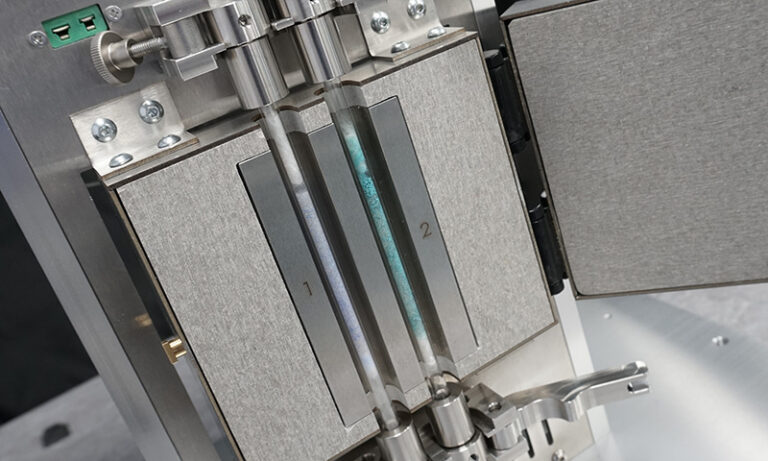
The research evaluated ammonia capture under conditions representative of real-world air treatment applications, using a feed stream containing 50 ppm ammonia, tested under both dry conditions and humid conditions at 55% relative humidity.
Unlike traditional single-component uptake methods, breakthrough analysis observes material behavior under continuous flow with representative gas mixtures, monitoring ammonia concentration at the outlet of a packed sorbent bed to determine breakthrough capacity, saturation capacity, regeneration behavior, and the competitive effect of other gases.
1st Key Finding: Zeolite13X Performs Excellently in Dry Conditions
Zeolite 13X showed strong results under dry conditions, with a dynamic ammonia adsorption capacity of 1.97 mmol/g, excellent reproducibility across multiple adsorption-desorption cycles, and strong cyclic stability following thermal regeneration at 350°C.
2nd Key Finding: Humidity Has a Huge Effect on Behavior
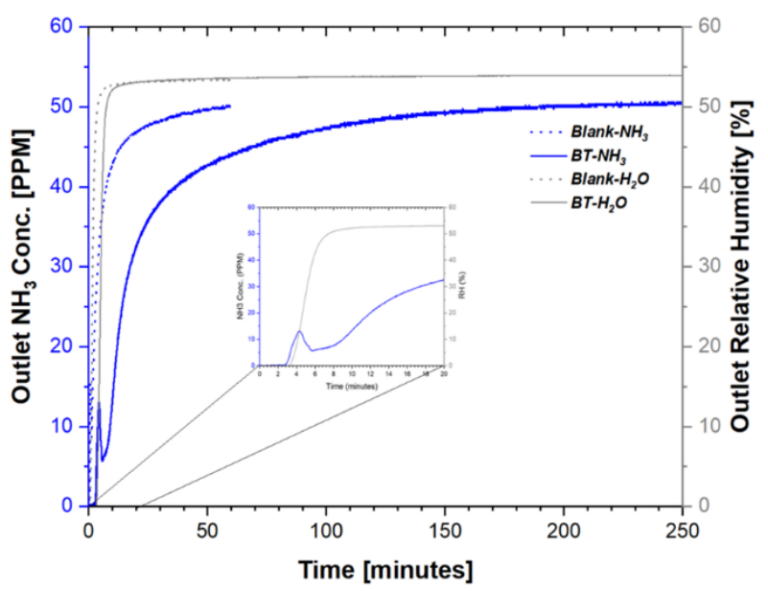
When exposed to a feed containing both ammonia and water vapor, the material’s adsorption behavior changed dramatically; ammonia broke through the packed bed much earlier than under dry conditions, indicating strong competition with humidity and suppression of ammonia uptake in its presence.
3rd Key Finding: 80% Reduction in Capacity
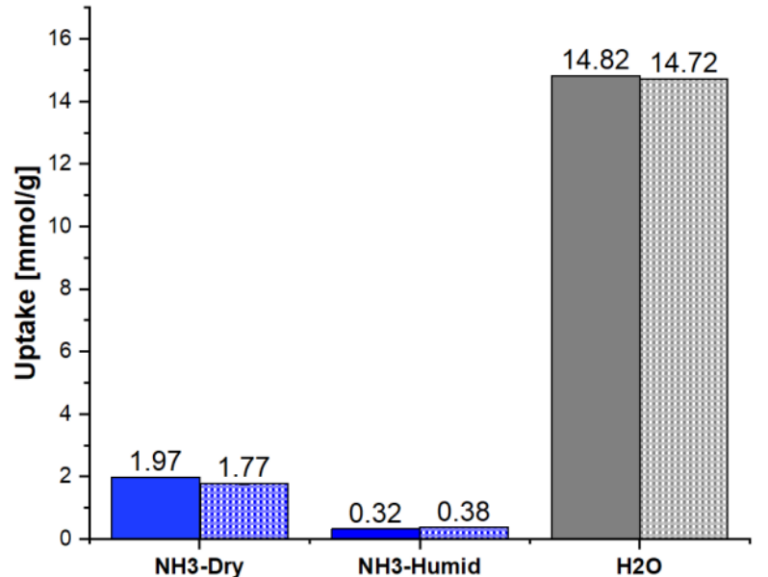
Adsorption (solid) and desorption (patterned) uptake from breakthrough experiments under dry and humid conditions
Under humid conditions, ammonia uptake dropped from 1.97 mmol/g to 0.32 mmol/g, an 80% reduction versus dry operation. Materials that excel in dry lab tests can lose substantial capacity once humidity enters the picture.
This is why testing against a single, static condition isn’t enough. Developers need to analyze competitive adsorption, breakthrough data, and regeneration behavior under real operating conditions, and tools like the BTA Frontier help teams make smarter, more informed decisions throughout R&D.
Want the full dataset behind these findings, including complete breakthrough curves, regeneration cycle data, and experimental parameters? Download the application note →
Developing Practical Ammonia Capture Solutions
Analytical instruments that enable realistic, multi-component testing are a game-changer for ammonia capture research. With humidity control, sensitive ammonia detection, and breakthrough analysis, researchers can understand the effects of competitive adsorption, regeneration, and material limitations at early stages, well before materials reach commercial testing.
For teams developing air treatment, gas purification, and environmental control solutions, this means faster, more confident material selection and process optimization.
Explore the BTA Frontier and see how dynamic breakthrough analysis can support your material development program.
Join Our Webinar: Evaluation of Adsorbents for Trace Pollutant Capture and Environmental Remediation

Ammonia is rarely alone; trace pollutants typically come mixed with competing gases and water vapor, and understanding that interplay is key to developing adsorbents that perform in the real world, not just the lab.
Join us on September 17 to explore how advanced materials characterization is helping researchers evaluate adsorbents for trace pollutant capture, from ammonia and SOx/NOx/VOC removal to CO₂ direct air capture, under realistic humidity and temperature conditions.