
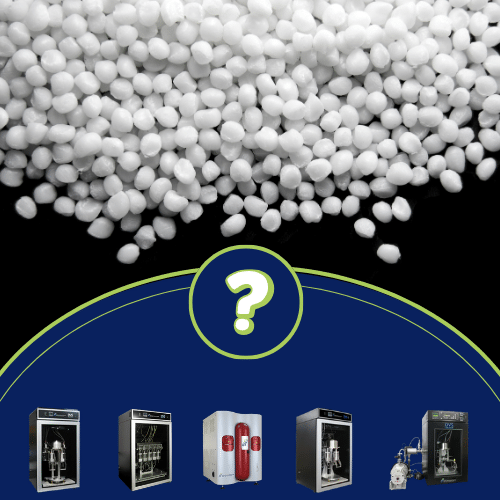
Polymers rarely operate under the dry, controlled conditions in which they are first characterized. Exposure to humidity, solvents, or other vapors can alter molecular mobility, transport behavior, dimensional stability, and processing performance. These changes make polymer-vapor interactions an important part of polymer characterization due to their influence on properties relevant to material processing, storage, and end use. Gravimetric vapor sorption measures these interactions directly by tracking mass changes during controlled vapor exposure.
1. Vapor permeability and diffusion kinetics
Determining how quickly water or organic vapor migrates through polymer films is crucial to polymer characterization for barrier applications. Permeant molecules can enter a polymer matrix, diffuse through its structure, and emerge on the opposite side. The rate of transport reflects factors including polymer chemistry, morphology, free volume, temperature, and vapor concentration.
Gravimetric vapor sorption monitors changes in sample mass over time under precisely controlled conditions. Kinetic analysis can provide diffusion coefficients (D), and suitable experimental configurations and appropriate transport models can enable permeability (P) measurements.
Small samples and thin films can also be studied without the lengthy measurement periods often encountered with conventional cup methods.
Practical applications of gravimetric vapor sorption include determining moisture barriers for recyclable food-packaging films, evaluating pharmaceutical blister materials that protect moisture-sensitive active ingredients, and studying proton-exchange membranes used in hydrogen fuel cells. Such measurements link molecular transport directly to functional material performance.
2. Solvent-induced glass transition and structural transitions
Water and organic solvents can act as plasticizers by increasing molecular mobility within a polymer. Consequently, exposure to vapor may depress the glass transition temperature (Tg), moving an amorphous material from a rigid glassy condition toward a softer, rubbery state.
Vapor sorption offers polymer characterization data across controlled relative humidity (RH) or solvent partial-pressure ranges. Changes in sorption behavior can indicate phase or structural transitions as increasing vapor activity modifies polymer mobility. Additionally, researchers can investigate the glass-transition relative humidity (RHg), which identifies the humidity at which a glass transition occurs at a specified temperature.
Identifying the humidity or solvent activity at which a glass transition occurs is vital for amorphous pharmaceutical polymers and drug-deliver matrices, where increased molecular mobility can alter physical stability or release properties. Similar information supports the assessment of polymer powders susceptible to caking and materials at risk of structural collapse during humid storage.
3. Moisture sorption isotherms and hysteresis behavior
Environmental sensitivity cannot be represented adequately by a single moisture-content measurement. Polymer characterization often needs to establish how water uptake changes across humidity levels and whether absorbed moisture follows the same pathway in subsequent drying.
High-resolution sorption and desorption isotherms map equilibrium mass against RH or vapor partial pressure. Their profiles provide information about water-polymer interactions, surface adsorption, bulk absorption, micropore filling, capillary condensation, and moisture-driven swelling.
Comparing adsorption with desorption also reveals hysteresis. Here, the material retains a different quantity of vapor at the same environmental condition depending on its exposure history. This behavior can indicate structural rearrangement, pore effects, swelling, or changes in polymer-water interactions. Engineers can use the resulting data when selecting protective polymer coatings for outdoor electronics, evaluating construction membranes exposed to seasonal humidity cycles, or assessing polymer components intended for humid industrial environments.
4. Organic vapor affinity and polymer swelling
Beyond water exposure, polymer characterization must consider contact with volatile organic compounds (VOCs), hydrocarbons, and industrial solvents. Strong polymer-solvent interactions can cause swelling, dimensional changes, softening, or deterioration, particularly in elastomers and cross-linked networks.
Organic vapor sorption uses selected solvent molecules as probes to quantify vapor affinity and uptake kinetics. Measurements across controlled solvent activities can support assessment of solubility parameters and swelling thermodynamics. Moreover, for rubber networks, gels, and elastomeric materials, solvent uptake can provide information related to cross-link density because network structure impacts the extent to which the polymer expands.
Relevant applications for organic vapor sorption include screening elastomer seals for hydrocarbon processing equipment, developing solvent-resistant protective coatings, and evaluating polymer membranes for chemical separations. These polymer characterization studies help connect solvent compatibility with the molecular structure responsible for swelling behavior.
5. Drying, curing, and solvent retention
Residual solvent and moisture can remain within polymer matrices after manufacturing, affecting mechanical strength, adhesion, coating uniformity, dimensional stability, and subsequent processing. Measuring only initial and final mass offers limited information about how volatile species leave the material during drying.
Controlled gravimetric experiments simulate defined temperature and humidity conditions and continuously record solvent or moisture loss. The final kinetic profiles show drying rates and release behavior, ensuring researchers can differentiate readily removed volatile fractions from molecules held more strongly within the polymer matrix.
Industrial relevance of controlled gravimetric experiments spans solvent-based paints, pressure-sensitive adhesives, structural composite resins, conformal coatings for printed circuit boards, and polymer encapsulants used around electronic components. Incorporating drying behavior into polymer characterization supports manufacturers with refining curing temperatures, residence times, and environmental conditions, reducing retained solvent without unnecessarily extending production cycles.
Advancing polymer characterization with vapor sorption
Diffusion, phase transitions, sorption hysteresis, swelling, and solvent retention each reveal a different aspect of polymer behavior, but all can be investigated through controlled sorption measurements. Surface Measurement Systems Ltd offers a range of instruments for polymer characterization studies. DVS Resolution, DVS Endeavour, and DVS Adventure support gravimetric sorption isotherms and kinetic analysis, while DVS Vacuum enables characterization across a broader pressure range. iGC-SEA Nova provides complementary data on surface thermodynamics, porosity, and gas or solvent interactions. This range of analytical capabilities allows scientists to investigate the material properties and mechanisms central to polymer development, processing, and performance. Speak with Surface Measurement Systems Ltd’s team of specialists now to find out more about our polymer characterization solutions, as well as which would fit with your research.